How to Judge and Appreciate AI Art as a Collector
Judging AI art well is a different skill from making it, and most collectors arrive with the wrong instincts. The first instinct is to ask how the image was made. The more useful instinct is to ask what it is doing. Once you separate the tool from the result, you can assess an AI-generated piece on the same terms you would use for any other image: composition, coherence, restraint, and whether it holds your attention after the surprise wears off.
Start With the Picture, Not the Label
Human judgement is easily swayed by attribution. Research published in Nature Scientific Reports in 2023 by Horton Jr and colleagues found that comparing images labelled as human-made with images labelled as AI-made increased perceptions of human creativity. The label changed the verdict, not the picture. If you know that about yourself, you can work around it.
Try a simple exercise the next time you browse a gallery or a portfolio. Cover the caption. Give the image a full minute, which is longer than most people manage. Decide what you think of it. Only then read who made it and how. You will often find that your first reaction was more honest than your second.
What Is Actually Worth Judging in an AI-Made Image
Because generation is fast, the interesting decisions move elsewhere. AI creates images faster than any human can, which means the effort sits in selection and direction rather than in rendering. That is where you should aim your attention.
-
Composition and structure. Does the image hold together as a shape on the wall, or does it fall apart into a pile of attractive detail?
-
Coherence of intent. Can you say what the picture is about in one sentence? If you cannot, it may simply be noise that happens to be pretty.
-
Colour and tonal control. Are the choices consistent across the frame, or does the palette drift without reason?
-
Restraint. Knowing what to leave out is a skill. Cluttered frames usually mean nobody edited.
-
Holding power. Look away, come back, and see whether it still works.
Notice that none of those criteria mention the tool. They apply equally to a painting, a photograph, or an image produced with a model. This is the point. Judging AI art is not a separate discipline with its own rules; it is the same discipline applied to a new source of raw material.
The Photography Precedent Every Collector Should Know
Artist Craig Boehman makes the historical comparison in his essay In Defense of AI Art. He recalls the old argument that photography could not be art because anyone could do it and it would put painters out of work. The parallel is not perfect, but it is instructive.
Photography did not replace painting. It forced painting to stop competing on likeness and to start competing on interpretation. Something similar may be happening now. If a machine can produce a competent image of almost anything, competence stops being the selling point. What remains is point of view. For a collector, that reframes the question from whether the image was made by hand to whether it was directed by a mind with something to say.
Where AI Art Is Genuinely Strong
One of the real strengths of generative tools is their ability to mix unexpected elements together, producing fresh perspectives and combinations that a person might not have considered otherwise. That is a creative contribution rather than a technical trick. Collections built around strange juxtaposition, impossible colour, or imagery that does not exist in the physical world have a natural home here.
Speed also matters more than it sounds. Rapid iteration lets a maker try twenty directions and keep one. A collector can see the evidence of that process in a strong body of work: range across pieces, consistency of voice, and a willingness to abandon ideas that are not working. Conversely, an AI portfolio where every image looks like the same prompt with small variations tells you the maker stopped making decisions.
What Human-Made Work Still Does Differently
There is a common argument that AI cannot understand human emotion and therefore cannot replicate it. That claim is widely made in these debates, and it is worth holding alongside a less comfortable one: art was not universally appreciated before AI arrived either. The difference now is attention, not sincerity.
What the research does suggest is that the presence of AI-generated art can enhance the perceived value of human-made work. That is a market and psychological effect rather than a quality judgement, and it cuts both ways. It does not mean every hand-made piece is profound. It does mean the two categories are not competing on the same axis, and a collector can reasonably want both.
A Practical Framework for Assessing a Piece
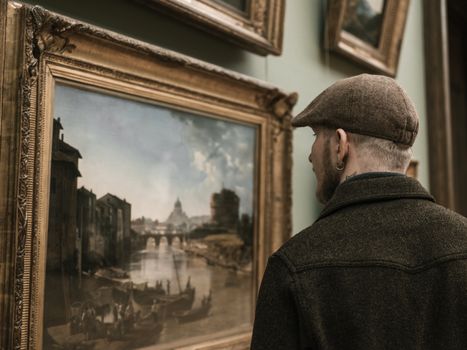
If you want a repeatable process rather than a mood, work through the following questions in order. They are deliberately simple, and they work on any image regardless of origin.
|
Criterion |
Question to ask |
A strong answer looks like |
|---|---|---|
|
Structure |
Does the composition hold at a distance? |
A clear focal point and deliberate balance |
|
Intent |
Can you state the idea in one sentence? |
A recognisable theme or mood |
|
Control |
Are colour and detail consistent? |
Choices that support the idea rather than distract |
|
Surprise |
Does it show you something unfamiliar? |
An unexpected combination that still makes sense |
|
Staying power |
Does it hold up on the tenth viewing? |
Interest that survives familiarity |
Score a piece honestly against those five and you will develop a consistent eye faster than you would by reading opinions about AI art online.
Market Signals and the Ai-Da Headline
In November 2024, a portrait of the British mathematician Alan Turing made history by selling at auction for $1.08 million. The artist, Ai-Da, is a robot, and the work is AI-generated. It is a striking story and an easy one to over-read.
A single record result is a headline, not a price guide. Most AI-generated work trades on entirely different terms, and the market for it is young. If you are buying with resale in mind, read the terms of the specific platform you buy from and check the rules that apply where you live, because the treatment of AI-generated work varies and is still developing. Confirm the current position with the relevant official source or the platform itself before you rely on it.
Training Your Eye Over Time
Art appreciation is a habit rather than a talent, and it improves with repetition. One useful way to think about it is the idea of wearing different hats or coloured lenses: you see what you have trained yourself to see. Change the lens and the same image yields different information.
-
Look at one new piece a day without reading the label.
-
Write a single sentence describing what the piece is doing.
-
Revisit the same maker’s work a week later and see whether your view changed.
-
Note when your opinion shifts because of attribution, and ask why.
-
Buy slowly, and only when a piece keeps winning the argument.
Collectors who follow something like this routine tend to end up with a coherent collection rather than a collection of curiosities. The tool behind the image matters less than the consistency of your own judgement.
Frequently Asked Questions
Why do people like AI art?
One common reason is creative access. People value AI art because it lets them explore their own creativity when they have neither the skills nor the time to draw what they want to see. Others are drawn to the speed of iteration, or to the unexpected combinations a model can produce. Liking it does not require believing it is better than anything else.
How would you describe AI art to someone who has not seen it?
Describe it as images made with generative models rather than by hand, where the human contribution sits in direction, prompting, selection and editing. The results can range from photorealistic to abstract, and quality varies enormously. It helps to add that the category covers everything from quick experiments to finished pieces that have appeared at major auction, so generalisations tend to fail.
Is AI art legal to buy and resell?
The rules vary by country and by platform, and they are still developing. Rather than relying on a general answer, check the terms of the marketplace you buy from and confirm the current legal position where you live with a qualified professional or the relevant official source. Treat any blanket claim that AI art is always safe, or always restricted, with caution.
What is a good way to express appreciation for a piece of artwork?
Say something specific. Mention the element that caught you, whether that is the colour, the composition, or an unexpected combination of ideas, and explain what it made you think about. Specific observations land far better than general praise, and they give the artist something useful in return. Honest curiosity is always a reasonable response.