
Crime Mystery vs Thriller: What Is the Difference?
Walk into any bookshop and you will see crime mystery and thriller titles sitting side by side. Publishers group them, online stores recommend them together, and readers often use the words as if they mean the same thing. The truth is that these genres share DNA, but they create very different reading experiences. A crime mystery asks you to look backwards and solve a puzzle. A thriller pulls you forwards, chasing the outcome of a dangerous situation. Understanding the difference can help you choose a book that matches your mood, and it can also explain why some novels you loved left you feeling clever while others left you breathless.
Why Mystery and Thriller Get Confused
It is easy to see why the two categories blur together. Both genres usually involve a crime, a person trying to find answers, and a satisfying resolution. Many books even blend elements of both. Throw suspense into the mix and the lines become fuzzier still. Suspense is not a genre in its own right so much as a feeling that keeps you turning pages, and both mysteries and thrillers rely on it.
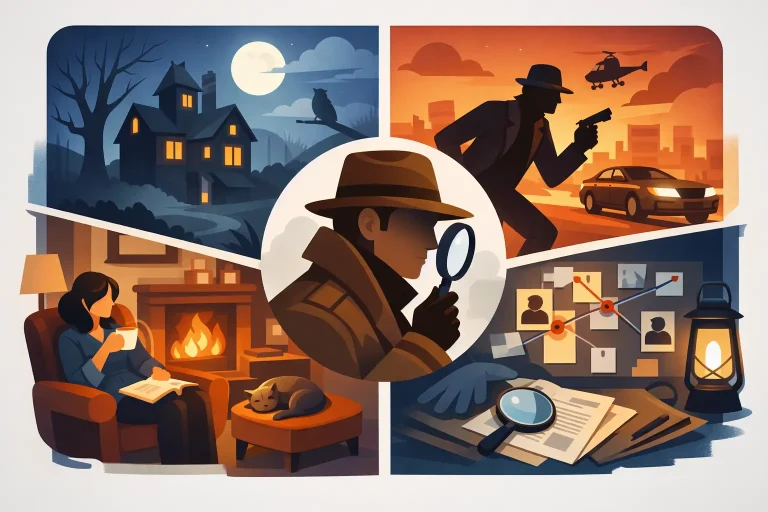
The confusion is understandable, but once you know what each genre is trying to do, the distinction becomes much clearer. Mystery is primarily concerned with solving a crime and pursuing justice. Thriller, at its heart, is centred on the main character and what they must do to survive, escape, or stop something terrible from happening. One genre is a puzzle to be assembled. The other is a race against time.
What Makes a Crime Mystery Different
A crime mystery is structured around a question from the past. Something has already happened, often a murder or theft, and the job of the protagonist, and by extension the reader, is to work out who did it and why. The story is essentially an investigation, and the author lays out a trail of clues, red herrings, and suspects for you to weigh up along the way.
This makes mysteries naturally puzzle-focused. A well-crafted mystery novel will contain clues that a careful reader can follow, so the satisfaction comes from reaching the solution just before, or just after, the detective does. There is a sense of fairness at work because the writer gives you the materials needed to solve the case, even if the answer only becomes obvious in hindsight.
At a deeper level, a mystery concerns itself with truth and the human capacity for deception and self-deception. The detective is not only hunting a culprit, they are also asking why ordinary people lie, hide things, or convince themselves that their secrets are safe. In cosy crime, historical, and traditional mystery fiction, this psychological element often matters as much as the identity of the killer.
What Makes a Thriller Different
A thriller operates on the opposite instinct. Instead of looking backwards at a completed crime, it looks forwards at something that could still happen. The central question is not “who did this?” but “can the protagonist stop it before it is too late?” A thriller is about trying to prevent a bad outcome, and the energy of the story comes from that urgency.
Thrillers are usually fast-paced and driven by the push and pull between the protagonist and the antagonist. In a thriller, a reader tends to ask “how?” rather than “who?” How will the hero escape this trap? How will they survive the danger closing in around them? The identity of the villain may be known from the start. Indeed, there is seldom any mystery as to who the criminal is, because the story often begins with a brilliant or daring crime and then follows the consequences.
Where a mystery emphasises the pursuit of justice and truth, a thriller emphasises the danger present in the world. The protagonist is often reactive, caught up in events beyond their control, and the plot is built around rising stakes, narrow escapes, and the constant threat of harm. It is less about gathering evidence and more about staying one step ahead.
Crime Mystery vs Thriller at a Glance
|
Aspect |
Crime Mystery |
Thriller |
|---|---|---|
|
Central question |
Who committed the crime? |
How will the danger be stopped? |
|
Timeline |
Looks backwards to solve what already happened |
Looks forwards to stop what might happen next |
|
Main focus |
Solving the crime and pursuing justice |
The protagonist’s survival and safety |
|
Reader experience |
Puzzle-focused, following clues and suspects |
Fast-paced, with rising tension and danger |
|
Knowledge of villain |
Identity is usually hidden until the reveal |
Villain can be known early; the question is how events unfold |
|
Typical structure |
Investigation, interviews, clue gathering, final reveal |
Escapes, confrontations, ticking clock, final showdown |
These points are not rigid rules. Plenty of novels weave both approaches together. However, the table offers a useful starting point for understanding what a book is likely to demand of you as a reader.

Where Crime, Mystery and Suspense Overlap
To complicate matters further, there is also the wider category of crime fiction. Crime stories focus on a criminal, circling the battle between good and evil, and the sense that a wrong needs to be avenged. That broad umbrella can cover police procedurals, legal dramas, private detective novels, and even stories told from the criminal’s perspective.
Within that umbrella, a crime thriller is a specific blend in which the central characters are involved in crime, either investigating it or committing it. The emphasis stays on the action and the danger rather than on solving a neat puzzle. Meanwhile, a suspense novel may sit somewhere in the middle, building anxiety about what is going to happen while still keeping some secrets from the reader until the final pages.
Genre labels are imperfect, and publishers often choose one term over another for marketing reasons. A book described as a psychological suspense novel might contain a mystery plot and thriller pacing in almost equal measure. That is why the most reliable way to choose a satisfying read is to ask yourself what kind of experience you crave.

How to Choose Between a Mystery and a Thriller
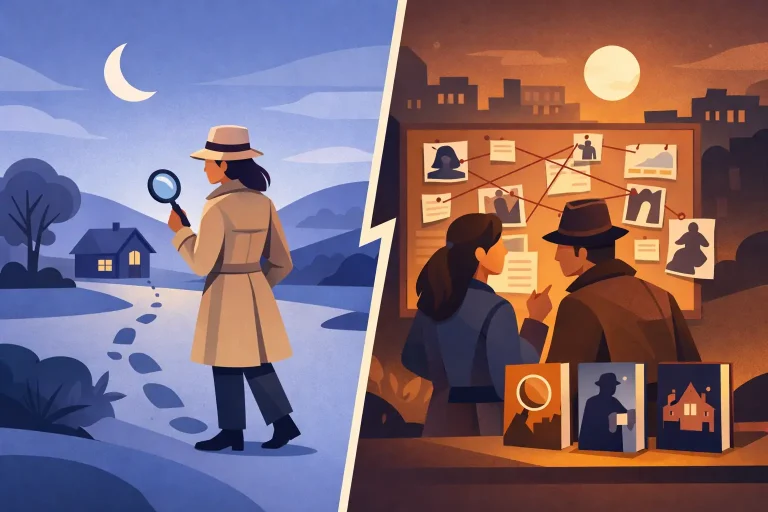
Consider what you most enjoy in a story. If you like the feeling of being an armchair detective, collecting small details, judging suspicious characters, and testing your theories chapter by chapter, then a crime mystery is probably your natural home. Traditional whodunits, village-set cosy mysteries, and historical detective series all belong to this family, and they reward patient, observant readers.
If you prefer momentum over deduction, and you would rather be swept along by danger, clever escapes, and a protagonist who is always under threat, then a thriller will serve you well. Thrillers are ideal for readers who want to finish a book in a weekend and who enjoy the adrenaline of a story that never slows down.
Your mood matters too. A cosy mystery offers comfort, familiar settings, and the reassurance that order will be restored. A thriller offers tension, uncertainty, and a glimpse of a more dangerous world. Both are excellent, but they satisfy different cravings, which is why genre-savvy readers tend to keep a stack of each nearby.
If you have ever picked up a book expecting a gentle puzzle and found yourself racing through a high-stakes chase instead, the fault may not lie with the book at all. It may simply be that you chose a thriller when you wanted a mystery, or vice versa. Knowing the difference between the two is not about locking yourself into one category. It is about giving each book a fair chance to deliver exactly what it promises.
Frequently Asked Questions
Is a thriller the same as a mystery?
No, although the two genres overlap often. A mystery is primarily concerned with solving a crime and pursuing justice, and it usually asks who committed the crime. A thriller is centred on stopping something bad from happening, often with the villain known from early on. The two can blend, but in pure form they create very different reading experiences.
Can a book be both a mystery and a thriller?
Yes, many novels deliberately combine both. A story can open with an unexplained crime, which is a mystery structure, and then build a fast-moving race against time as the investigation deepens, which is a thriller structure. When both elements are strong, publishers may label the book crime fiction or suspense because neither single term captures the whole blend.
Which should I choose if I enjoy cosy crime novels?
Readers who enjoy cosy crime and traditional whodunits will usually feel most at home with mysteries rather than thrillers. Cosy novels are character-driven, often set in small communities, and focus on gathering clues and revealing secrets rather than graphic danger or relentless pursuit. If you prefer gentle pacing and satisfying reveals, a mystery is your safest bet.