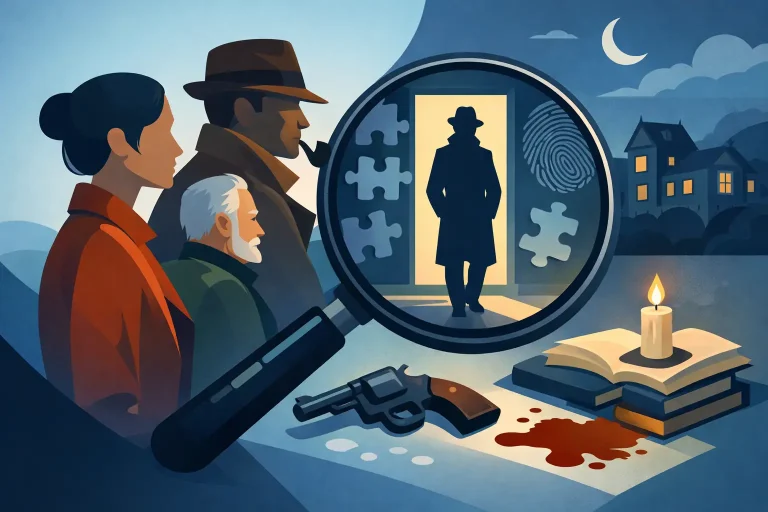

Character-Driven Mystery Novels: Why We Follow the Sleuth
A body in a library. A locked room. A suspect list pinned to the wall of an incident room. The ingredients of a mystery are easy to list, and yet two novels with almost identical ingredients can feel completely different to read. One keeps you turning pages because you must know how the trick was done. The other keeps you turning pages because you have grown fond of the person doing the detecting and you want to know how they will cope.
That second kind of book is what readers mean by character-driven mystery novels. The crime matters, obviously. Nobody wants a whodunit where the answer is an afterthought. But the lasting pull comes from the sleuth: their habits, their opinions, their quietly stubborn sense of right and wrong. It is the subject the Clued In Mystery podcast picked apart with author Trixie Silvertale, discussing what makes a mystery character driven and why mystery fans tend to prefer stories that focus on character over the puzzle alone.
What Character-Driven Means in a Mystery Novel
A quick test works better than a definition. Take the detective out of the book and ask whether there is still a novel left. In a purely plot-driven mystery, the answer is often yes: the puzzle would survive a swap. In a character-driven mystery, the particular way the sleuth sees the world is the engine. Their stubbornness, their curiosity, their private loyalties and their blind spots all shape which clues get noticed and which get missed.
It helps to be clear about what the label does not mean, because it is often used as a polite way of saying slow or plotless:
- It does not mean the plot can be sloppy. A weak solution ruins a character-led mystery as thoroughly as any other.
- It does not mean the crime is unimportant. The investigation is the pressure that reveals who the sleuth really is.
- It does not mean the detective has to be likeable. Difficult, prickly and awkward sleuths have devoted followings.
- It does not mean the book lacks suspense. Caring about the person in danger raises the stakes rather than lowering them.
The Sleuth Is the Real Puzzle
Look at the names that turn up whenever readers argue about the best mystery characters of all time. A widely shared ranking from ProWritingAid includes C. Auguste Dupin, Hercule Poirot, Miss Marple, Philip Marlowe, the Hardy Boys, Nancy Drew and Perry Mason. Notice how little that list has to do with individual crimes. Almost nobody remembers these characters because of one clever murder. They are remembered for a manner of speaking, a set of routines and a moral line they will not cross.
That is the trade a character-driven mystery makes with its reader. The puzzle is solved and set aside, but the detective accumulates. Each case adds another small piece of biography, another friendship, another grudge. Fans of long-running series are not really collecting plots. They are collecting time spent with someone whose company they enjoy.

Why Long-Running Series Suit Character Readers
Penguin’s round-up of the best long-running mystery and detective series makes the appeal plain, naming Georges Simenon’s Inspector Maigret novels alongside Agatha Christie’s Hercule Poirot books. There is a particular pleasure in discovering a series that already runs to dozens of titles, because the reader knows there is more to come and no need to say goodbye yet.
The same instinct shows up in reader recommendation threads. When people ask for intriguing mystery series with great characters, the replies cluster around a handful of names: Richard Osman’s Thursday Murder Club, Robert Galbraith’s Cormoran Strike books, Clare Mackintosh’s DC Morgan series, Sherry Thomas’s Lady Sherlock. Different eras, different tones, but the same request underneath. Readers want a voice they can settle into for more than one book.
A Few Sleuths Readers Keep Returning To
| Sleuth or series | Author |
|---|---|
| Hercule Poirot | Agatha Christie |
| Miss Marple | Agatha Christie |
| Inspector Maigret | Georges Simenon |
| Thursday Murder Club | Richard Osman |
| Cormoran Strike | Robert Galbraith |
| DC Morgan series | Clare Mackintosh |
| Lady Sherlock | Sherry Thomas |
Plot Still Has to Hold Its Weight
Character-led does not mean plot-light. The mechanics of a mystery are unforgiving. Writers Helping Writers sets out the character and plot elements readers expect from a mystery story, and the essentials have not changed: a crime worth investigating, a believable pool of suspects, clues planted fairly enough that an attentive reader could in theory solve the case, and a reveal that reorders everything that came before.
What changes in a character-driven novel is where the tension lives. In a puzzle-first mystery, the tension sits inside the solution. In a character-led one, the solution is also a personal reckoning. The sleuth may be forced to confront a friend, admit a mistake or choose between the truth and something they would rather protect. The clue that cracks the case usually cracks the detective too, at least a little.
That balance is why so many authors working in the traditional and cozy traditions spend as much time on the detective’s home, friendships and daily routines as on the suspects. The village, the kitchen, the walk to the shop: all of it builds the person who will eventually point at the right suspect and explain why.

Reading Slumps and the Comfort of a Familiar Voice
Character-driven series have a practical advantage that rarely gets mentioned in reviews. They are easy to restart. One reader in an online book group described how she used to read constantly before children, then barely finished a book in six years, and wanted a mystery series to help her slow the scroll and get back into the habit. The recommendation she needed was not a clever locked-room puzzle. It was a detective with a voice she would want to hear again at the end of a long day.
A complex plot demands momentum you may not have. A familiar character asks far less of a tired reader. You can pick the book up, spend twenty minutes in company you like, and put it down again without losing the thread of a dozen interlocking timelines. For anyone returning to reading after a gap, that is no small thing.
How to Tell Whether a Mystery Will Be Character-Led
Book blurbs are not always helpful, so here are the signals worth looking for before you commit:
- The description mentions the detective’s personality, history or circumstances, not only the crime.
- It is part of a series with a named sleuth rather than a standalone with a rotating cast.
- Reviews mention the main character by name, or talk about the detective’s relationships, rather than just the twist.
- The setting feels like a place the sleuth belongs to, with neighbours, routines and long memories.
- Readers describe the book as comforting or warm rather than merely clever.
If two or three of those apply, you are probably holding a character-driven mystery. If all five apply, you may have just found a series to read for years.

Where Our Own Sleuths Fit
The Mystery Collective is built around exactly this kind of reading. Three published authors, Clara Willow, Gideon Harrow and Rosalind Fenwick, write across cozy, historical and traditional mystery territory, with sleuths and village secrets at the heart of the books rather than gore or shock. If you have read this far and found yourself nodding at the idea that the detective matters more than the body count, their shelves are the obvious next stop. Print editions and eBooks are available, so you can start a series in whichever format suits your reading habits.
Frequently Asked Questions
What makes a mystery novel character driven?
A character-driven mystery puts the detective’s personality, instincts and private life at the centre of the story. The crime still has to be solved and the clues still have to add up, but the reader’s main interest is in how the investigation changes the person leading it. Remove the sleuth and the book would collapse.
Do character-driven mysteries still have strong plots?
They should, and the best ones do. A character-led mystery cannot coast on personality alone. Readers expect fair clues, credible suspects and a reveal that makes sense of everything that came before. Plot and character work together: the puzzle creates pressure, and the pressure shows you who the sleuth really is.
Why do readers prefer mystery series to standalone novels?
Because a series lets you stay with someone you have come to like. Long-running series such as Georges Simenon’s Inspector Maigret novels or Agatha Christie’s Poirot books show how much appetite there is for a detective followed across many cases. Returning to a familiar voice is easier than starting from scratch, particularly after a reading slump.
Which character-driven mystery series should I start with?
Reader recommendations often mention Richard Osman’s Thursday Murder Club, Robert Galbraith’s Cormoran Strike books, Clare Mackintosh’s DC Morgan series and Sherry Thomas’s Lady Sherlock. For something older, try Agatha Christie’s Poirot or Miss Marple novels, or Georges Simenon’s Maigret. Read the opening chapter of two or three and continue with whichever voice you want to hear again.