AI Art Training Data: What Artists Should Ask
Training data sits underneath every AI image tool an artist might pick up. It shapes what the model produces, whose style it echoes and whose work went into the machine without a conversation. For illustrators, pixel artists and designers who publish online, the question is rarely abstract. It is about whether a piece you posted years ago became part of a model you are now being told to adopt. What follows are the questions worth asking, along with what the available research does and does not settle.
Why training data matters to working artists
Every image model learns from a body of examples. That body of examples decides which visual conventions the model reproduces, which styles it can imitate and whose labour went unpaid in the process. Reporting on the subject has repeatedly centred on scale: the plaintiffs in ongoing litigation allege that companies unlawfully scraped and used billions of copyrighted images to train generative AI models without consent, credit or compensation. Those are allegations rather than settled findings, but they describe the practical worry many artists have when they see their own work reflected in a generated result.
For anyone who publishes online, the exposure is cumulative. A portfolio, a shop listing, a sketch posted to social media: each is a candidate for inclusion in a scraped dataset. The question is not only whether you object, but whether you can find out, and what you can do with the answer.
What a training dataset actually contains
Image models are usually described as being trained on pairs of images and text. The text, often a caption or alt text collected alongside the picture, teaches the model associations between words and visual patterns. Tools such as Have I Been Trained have expanded to target the text of captions before running a CLIP retrieval step, which shows how much weight the accompanying language carries in a dataset.
It helps to separate three things that get muddled in conversation:
- The dataset: the collection of images and captions used during training.
- The model: the resulting system that produces outputs.
- Your prompt: the text you type at generation time.
A prompt is an input to generation, built on the training data, the language model and the latent space the tool works within, rather than a record of what the model learned. Even so, it is worth reading a tool’s terms to see what happens to the text and images you submit, and whether they are retained or reused.
Questions to ask about any AI art tool
Clear answers are rare, but the asking matters. A supplier that can describe its data provenance is telling you something useful, and one that cannot is also telling you something.
- What was the model trained on, and is the dataset documented anywhere public?
- Was the data licensed, opt-in, or collected by scraping?
- Can I search the dataset for my own work, or request that someone does?
- Is there an opt-out route, and does it apply to future versions of the model as well?
- What happens to images and prompts I upload while using the tool?
- If my work turns out to be in the dataset, what remedy is offered?
- Who is accountable if the answer changes after a retrain?
Transparency is the sticking point. Work published in May 2024 on the transparency of databases and their content noted that the data used to train AI models is increasingly being kept hidden. When the dataset is not disclosed, the questions above become harder to answer and harder to verify.
How to check whether your images were used
Search tools are the most direct route available to individual artists. Have I Been Trained lets you search by name, and its move to examine caption text before CLIP retrieval reflects a push for better matching. Writing in September 2023, Art Business News noted that software tools exist to help you determine whether an AI art model used a training dataset that included your image.
Treat a search as evidence, not proof. A positive match is a strong prompt to ask further questions. A blank result may mean your work was not included, or that the dataset was never indexed by the tool you used, or that the matching method missed it. Record what you find, with dates and screenshots, because datasets are revised and a result can change between checks.
Why generated images often cannot be traced back
Researchers at MIT CSAIL found that images generated by AI models trained on massive datasets often cannot be traced to specific training images. That finding cuts both ways. It weakens the idea that you can prove derivation simply by pointing at an output, and it weakens the idea that a model’s outputs can be credited to identifiable authors in any straightforward way.
For a working artist, the practical consequence is that attribution arguments need to rest on more than visual similarity. A screenshot of a generated image that resembles your style is not a dataset record. The dataset record, where one exists, is the stronger evidence.
Consent, credit and compensation in current disputes
The public argument has settled around three words: consent, credit and compensation. Reporting on Stable Diffusion’s training data puts all three at issue, and opt-out campaigns have drawn attention too, with artists reported to be opting out of AI training datasets in large numbers. That suggests many creators want a say even where they are not pursuing a claim.
Legal positions differ between jurisdictions and cases are ongoing, so any decision about your own work should be checked with a solicitor or the relevant official source rather than taken from a blog post. What you can do now is keep your own records and make your preferences known in writing.
What a well-documented dataset looks like
Licensed alternatives exist, and they show what the other side of the argument looks like in practice. Some providers advertise custom multimodal training data built by a pool of more than 700,000 creators and described as ethically sourced and fully licensed for any modality or use case. The contrast with an undisclosed scrape is stark, and it gives artists a reference point: a dataset that can name its contributors, state its licence and explain its collection method.
Ask potential collaborators and clients which of those two models they are working with. A studio that can answer in specifics is a lower risk than one that cannot.
A practical checklist for your own practice
The steps below are about reducing uncertainty rather than eliminating it.
- Keep dated records of when and where you published each significant piece.
- Run a search for your name on the available training data tools, and save the results.
- Read the terms of any AI tool before uploading your own images, and check what it does with prompts and uploads.
- Use opt-out mechanisms where a provider offers one, and keep confirmation of the request.
- Ask suppliers and clients what they know about the provenance of the models in their workflow.
- Prefer tools and data providers that can describe their licensing clearly.
- Take advice before relying on a specific legal position in your own country.
Where the flood of generated images fits in
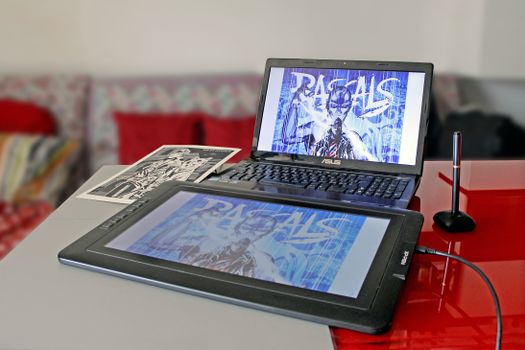
The volume problem compounds the provenance problem. By August 2022, commentators were already observing large quantities of AI-generated images from tools such as DALL-E, Stable Diffusion and Midjourney flooding the internet, and noting that the flow would only increase. A web dense with synthetic images makes verification harder for buyers, curators and artists alike, and raises the value of clear documentation on your own side.
What the research does not settle
Several things artists often want to know are simply not answered by what is publicly available. There is no reliable way, from an output alone, to name every image that contributed to it. Opt-out lists do not guarantee removal from models already trained. Disclosure practices vary and are changing. Any source that offers a confident answer to those points without evidence deserves scepticism.
What you can do is treat the subject as a documentation exercise: ask, record, follow up, and note where an answer was refused or unavailable.
Frequently Asked Questions
Can I find out if my artwork was used to train an AI model?
Sometimes. Search tools such as Have I Been Trained allow you to look for your name or your images, and software designed to check whether a dataset included a particular image has been available since at least 2023. A positive match is useful evidence. A blank result is not proof that your work was excluded, because coverage varies between tools.
Does opting out remove my work from a model that has already been trained?
Not necessarily. An opt-out usually affects future use of your work in datasets rather than the weights of a model already trained. Artists have been reported to be opting out in large numbers, which shows demand for a say, but an opt-out is a preference rather than a guarantee. Ask the provider what the request covers and keep written confirmation.
Are AI-generated images traceable to the artists whose work trained the model?
Often they are not. Researchers at MIT CSAIL found that images produced by models trained on very large datasets frequently cannot be traced to specific training images. That makes visual similarity a weak form of proof and puts the emphasis on dataset records, search results and documentation rather than on the appearance of an output.
Is training an AI model on copyrighted images lawful?
The point is contested. Litigation has alleged that companies scraped and used billions of copyrighted images without consent, credit or compensation, and those claims have not been finally resolved in the reporting surveyed here. The position varies by jurisdiction, so check with a solicitor or the relevant official body before acting on any assumption.
What should I ask before supplying images to a client or platform?
Ask what the images will be used for, whether they will be used to train or fine-tune a model, who owns the resulting model, and whether you can withdraw later. Put the answers in the contract. If the other party cannot describe their licensing or data handling in specifics, treat that as a warning sign rather than paperwork to sort out later.