AI Art in Museums: How Galleries Are Adapting
AI Art in Museums
Artificial intelligence reached museums through the back door. Long before any gallery hung a generated canvas in a principal room, staff were already using AI tools to draft text, translate labels and summarise documents. The visible change, the kind visitors actually notice, is arriving more slowly and with more argument attached. Some institutions now build exhibitions around machine-made work. Others use AI quietly to shape what a visitor sees next. A few have discovered that publishing generated imagery under a respected institutional name can become a reputational problem within hours.
What counts as AI art in a museum context
The phrase covers more ground than most people assume. At one end sit images produced from text prompts and hung as finished pieces. At the other sit video installations where a language model acts as a collaborator rather than the author. A curator deciding where AI belongs in a programme has to separate the tool from the artwork, because a museum using AI to draft its wall text is making a very different statement from one exhibiting AI-generated portraiture.
That distinction matters for audiences too. Visitors bring expectations about authorship, originality and labour. When a gallery frames an algorithm as the creator, the question of who did the work lands immediately. When a gallery frames the model as something closer to a brush in a human artist’s hand, reactions tend to be softer and the conversation shifts to process rather than authenticity.
How AI is reshaping the visitor experience
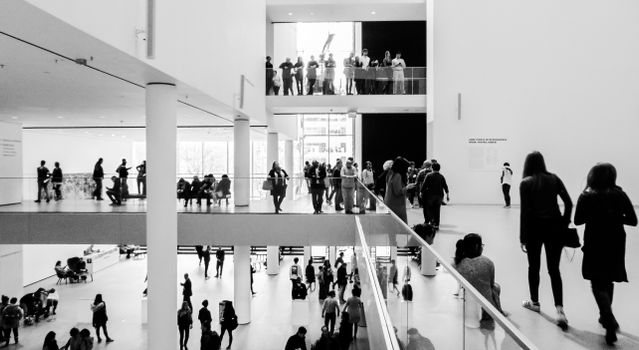
The most widespread visitor-facing applications are not artworks at all. AI-powered applications in museums allow visitors to tailor their museum journey according to their own interests, receiving relevant information as they move through the building. Instead of one fixed route through a permanent collection, the visit bends towards whatever the individual came for.
Behind that sits a more ambitious idea. A proposed visitor tracking system, reported in November 2024, would allow museum staff to understand visitors better and adapt to them in several ways. That could mean adjusting signage, timing or content based on how people actually behave rather than how curators assume they behave. Analysis of this kind is not only about comfort. According to UNESCO, AI-powered analysis aims to enhance museum arrangements, manage crowd movement and significantly enhance visitor satisfaction.
For large sites dealing with coach parties, school groups, timed ticketing and fragile rooms, smoothing the flow of people is part of protecting the collection as well as improving the day out. Fewer bottlenecks near a delicate object means fewer incidents, and clearer routes mean visitors spend more time looking and less time queuing.
|
Area of museum work |
How AI is being applied |
What the reporting suggests |
|---|---|---|
|
Visitor guidance |
Tailoring a visit to individual interests and supplying relevant information |
Shifts the visit away from a single fixed route |
|
Space and crowd management |
Analysis intended to improve arrangements and manage movement |
Aimed at enhancing visitor satisfaction |
|
Authenticity checks |
Detecting counterfeit art sold online |
Described as a critical tool as physical forgery networks are targeted |
|
Behind the scenes |
Drafting, translation and summarising |
The most common everyday and exploratory use |
Authenticity, forgery and the quiet operational win
One of the least glamorous uses may prove to be among the most valuable. In March 2025, reporting on the role of AI in dismantling international art forgery rings described the technology as a critical tool in detecting counterfeit art sold online, at a time when authorities are cracking down on physical forgery networks.
That matters because the market for fakes has moved partly online, where a buyer may never handle the object before purchase. Authentication has always relied on expertise, provenance paperwork and comparison against known works. Machine-assisted analysis adds another layer of scrutiny to a process that human specialists cannot scale indefinitely. Museums and galleries, which hold both the reference collections and the reputational stake, sit at the centre of that effort.
Exhibitions that put AI in the frame
Curatorial interest has moved well past novelty. Reporting in January 2024 described a Singapore Art Museum exhibition built around AI, showing work by 20 artists and focusing on the emerging genre of AI portraiture. A room of machine-assisted portraits raises questions that a single headline piece cannot: what does a portrait mean when the face is synthesised, and what is the artist actually doing?
Established practitioners have taken the same tools in unexpected directions. The Thai filmmaker and artist Apichatpong Weerasethakul began experimenting with ChatGPT-3 before it became mainstream, using it to generate fictional conversations with deceased figures such as the artist Salvador Dalí and the philosopher Jiddu Krishnamurti, and even with non-human entities such as the sun. Those imaginary exchanges were combined with diaristic footage of Thailand shot over several years to form the video installation A Conversation with the Sun (2022).
What that example shows is that AI art in museums does not have to mean a wall of generated pictures. The model can function as a scriptwriting device, a way of producing text that a human artist then frames, edits and places. The output is only one component of a work shaped by years of filming and a clear authorial voice.
When generated imagery damages public trust
The cautionary example is close to home for UK audiences. The British Museum posted a series of AI-generated images to social media. They were offensive, and they were removed within six hours following a strong backlash. Whatever the intention behind the posts, the episode illustrated how quickly institutional credibility can be dented when generated content is published without sufficient review.
The lesson is not that museums should avoid AI. It is that the approval chain for a generated image needs to be as rigorous as the approval chain for a printed label. A museum’s name carries the weight of scholarship and stewardship, and an audience that trusts a gallery to interpret objects will not extend that trust to unfiltered machine output.
The policy gap nobody has closed
Adoption has outpaced governance. One museum-sector survey found that 57% of museums use AI, yet 55% have no internal AI policy. Most of that use is everyday and exploratory: drafting, translation, summarising. These are not dramatic applications, but they touch press releases, accessibility text, internal notes and correspondence, which means the reputational and ethical questions arrive long before anyone proposes an AI exhibition.
An institution without a written policy is relying on individual judgement. That works until it does not. A short internal framework covering disclosure, review, image sourcing and who signs off on generated content costs far less than recovering from a poorly considered post.
What this shift means for working artists
For artists, the museum world’s slow adoption is an opportunity rather than a threat. Galleries and curators need people who understand both the tools and the traditions, and they need work that holds up when it is examined closely rather than scrolled past. That is a different standard from the one applied on a social feed.
Documentation becomes part of the practice. Keeping prompt histories, drafts, source material and process notes gives a curator something to write about and gives a buyer something to trust. Artists who can explain their decisions, including where the model stopped and the human started, are far easier to programme than those who present an unexplained output.
For anyone building a portfolio around this work, the sensible approach is to treat AI as one technique among several rather than a personality. Mixed practice, where generated elements sit alongside pixel work, drawing or photography, reads as deliberate. A gallery wall is an unforgiving test for anything that only works as a thumbnail.
Where this leaves the gallery visit
Two changes are happening at once, and they are easy to confuse. One is the arrival of AI-made work in exhibition programmes, which is visible, debatable and still relatively rare. The other is the spread of AI through the everyday machinery of running a museum, from visitor guidance to authentication to the drafting of text. The second is far larger and far quieter.
Visitors will notice the first and rarely see the second. That imbalance is worth holding on to when the topic generates heat. A gallery experimenting with a personalised route through a collection is not making the same claim as a gallery hanging a generated portrait, even though both are described as AI in museums. Keeping those strands separate is how the conversation stays useful.
Frequently Asked Questions
How are museums actually using AI day to day?
Mostly in unglamorous ways. One museum-sector survey found that 57% of museums use AI, yet 55% have no internal AI policy, and the dominant uses are everyday and exploratory: drafting text, translation and summarising documents. Exhibition programming and visitor-facing AI tools attract the headlines, but administrative assistance is where adoption is broadest at present.
Has AI art been shown in a major museum?
Yes. Reporting in January 2024 described a Singapore Art Museum exhibition built around AI, featuring work by 20 artists and focusing on the emerging genre of AI portraiture. AI-assisted work has also appeared in video installations elsewhere, including Apichatpong Weerasethakul’s A Conversation with the Sun (2022), which used generated conversations combined with years of diaristic footage from Thailand.
Can AI help spot forged artwork?
It is being used in that way. Reporting from March 2025 described AI technology as a critical tool in detecting counterfeit art sold online, at a time when authorities are cracking down on physical forgery networks. Buyers should still rely on established provenance checks and qualified expertise, since machine analysis supports authentication rather than replacing it.
Why did the British Museum’s AI images cause a backlash?
The museum posted a series of AI-generated images to social media. They were offensive, and they were removed within six hours following a strong backlash. The episode shows how quickly institutional trust can be damaged when generated content is published without adequate review, particularly by an organisation whose authority rests on scholarship and careful interpretation.
Do museums have rules about using AI?
Often not. The same survey evidence suggesting that 57% of museums use AI found that 55% have no internal AI policy. In practice this means decisions rest on individual staff judgement rather than a written framework. Institutions looking to formalise their approach usually need to cover disclosure, review, image sourcing and sign-off before any generated content goes public.