AI Artist vs Traditional Artist: Key Differences in 2026
In 2026, conversations about creativity keep returning to one question: how should we compare an AI artist with a traditional artist? The honest answer is that it depends on what you value. Producing an image has never been easier, yet the human skill behind it and the human story within it have not changed. Understanding the differences matters for practising artists, for buyers and for anyone who cares where art is heading.
What the Terms Actually Mean
Traditional art is made by hand, using physical materials such as paint, charcoal, clay or ink. The creator builds the image directly, and the finished piece carries visible evidence of that manual process. What is often called AI art is created through algorithms and digital prompts. The human input happens mostly before the image exists, in the writing of prompts and the selection of machine-generated outputs.
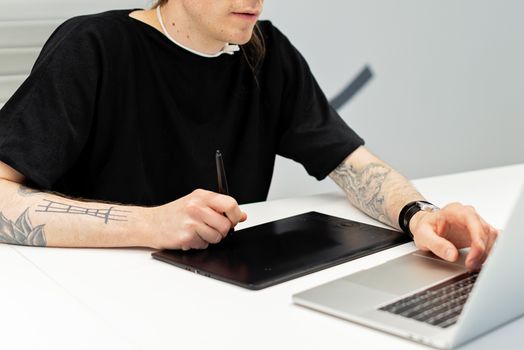
It is also worth separating digital art from AI art. The two are sometimes treated as the same thing, but they are not interchangeable. Digital artists must learn their craft through practice and mastery of their tools over time; they still make every mark themselves, even when the canvas is a screen. AI artists direct a machine instead. The creative responsibility is shared with an algorithm in a way that it is not shared in digital painting.
Skill, Training and the Creative Process
Skill is the area where the two practices separate most sharply. A traditional artist spends years learning the fundamentals of line, tone, colour and form. A digital artist completes a similar apprenticeship, mastering software, brushes, layers and the digital toolkit. Neither route offers an escape from practice. Mastery is earned through repetition, critique and correction.
AI art does not require the same artistic skill. With well-chosen prompts, users can generate complex imagery without formal training in drawing or painting. The AI artist’s craft lies in judging the output, refining the instructions and deciding when to stop. These editorial choices matter, but they are not the same as constructing an image through thousands of deliberate manual decisions.
Emotion, Originality and Human Intention
Defenders of traditional art argue that the most important elements of a work cannot be handed to a machine. AI lacks the emotions that create art. It can generate an image of grief or joy, but it has never grieved or rejoiced. Traditional artists work from memory, lived experience and feeling, and that human context is part of what viewers respond to.
The originality question follows a similar path. Critics argue that AI art is not original in the way human art can be, because nothing like a human point of view stands behind it. AI art also lacks a dialogue with the values and experiences that inspire human artists. It can borrow, combine and echo those values, but it cannot encounter them. That missing dialogue is one reason the work can feel shallow, no matter how polished the image appears.
These limitations do not mean AI imagery is without merit. It can inspire, provoke and decorate. But merit and artistic value are not identical. The viewer who knows an image was generated by algorithms evaluates it differently from one who sees the trace of a hand. That shift in perception sits at the heart of the 2026 conversation.
The Question of Value
Many commentators argue that AI art is inherently less valuable than traditional art, precisely because it subtracts the uniquely human labour, risk and emotion that give an artwork its depth. They are equally clear that AI art is not worthless. It has an audience, it can be sold, and it can bring pleasure. The value gap is about process: what was risked, who made it and what the work cost the maker.
Risk deserves emphasis. When an artist works directly with paint or clay, every decision carries the possibility of failure, and that risk becomes part of the achievement. An AI image can be regenerated endlessly at almost no cost. Handmade work therefore reflects a human being pushing against the limits of skill and chance, while an algorithmically generated image reflects a set of instructions carried out with predictable reliability.
Buyers and the Market in 2026
Commercial realities sit uneasily alongside these philosophical objections. Art created by AI definitely has an audience and potential buyers. The market for AI-assisted imagery is real, and public interest continues to grow as generated artwork becomes better and faster. Pretending this audience does not exist is unhelpful for anyone trying to earn from creative work.
At the same time, the arrival of AI has not emptied traditional galleries or workshops. Artists working in traditional mediums are not seeing significant opportunities taken away from them. The two markets run alongside each other rather than consuming each other. Traditional work continues to find buyers who value the skills and story of a human maker, while AI work attracts a different audience with different expectations.
Can Both Approaches Coexist?
Coexistence is not only possible; in many studios it is already standard practice. The most successful approach appears to be blending rather than choosing. An artist might begin a piece by hand, photograph it and refine it on screen. Another might use AI to explore compositional ideas, then recreate the strongest concept with manual skill. In both cases the artist retains creative control, using technology to serve an idea rather than replace its author.
Profitability is part of the reason so many artists experiment with hybrid workflows. Physical originals, digital prints and AI-assisted pieces can all contribute to an income, and no single formula works for everyone. What working artists keep advising is to blend both approaches to create human, sellable work, even in a market that is increasingly automated.
The goal, as many artists now describe it, is to keep human judgement at the centre of every decision. When treated as one tool among many, AI becomes an extension of the artist rather than a substitute for the artist.
Choosing a Path in 2026
Do you need to be a traditional artist to succeed in 2026? No. Do you need to adopt AI to stay relevant? Also no. The artists who feel stuck are usually the ones who believe they must commit to a single camp. The middle ground is crowded with possibilities for those who learn broadly, practise consistently and remain honest about how their images were made.
The right choice depends on what you enjoy. Some creators need the physical connection of traditional materials; others prefer the control of a stylus and screen; others enjoy the collaborative relationship with machine intelligence. Whichever route you take, respect the strengths and limits of the others. An AI artist who understands traditional principles is a stronger artist. A traditional artist who understands AI is better equipped to explain why handmade work still matters.
Frequently Asked Questions
Is AI art completely worthless?
No. AI art is not worthless, even though many commentators argue that it is inherently less valuable than traditional art. The reason is that AI output subtracts the uniquely human labour, risk and emotion that sit behind a handmade piece. AI imagery continues to find an audience and buyers, but the debate about its worth depends on how much value you place on the creative process itself.
Do traditional artists lose opportunities to AI?
So far, traditional artists are not seeing significant opportunities taken away from them. Art created by AI definitely has an audience and potential buyers, but that market appears to be growing alongside the existing market for handmade work rather than replacing it. Traditional work still appeals to buyers who value skill, personal expression and the story of a human maker.
Does AI art require artistic skill?
It requires a different kind of skill. Traditional and digital artists learn their craft through practice and mastery of their tools over time. AI users can generate imagery without that long apprenticeship, but they still need taste, patience and judgement. Prompting, editing and selecting outputs are genuine abilities, yet they are not the same as drawing or painting, and confusing the two leads to poor work and confused criticism.
Can one person be both an AI artist and a traditional artist?
Yes. Many artists now blend both approaches to create work that feels human and benefits from machine speed. The practical aim is to make sellable pieces with human judgement at the centre of the process. Traditional skills inform better prompting, and AI tools can expand what a traditional artist attempts. The two identities can enrich each other rather than cancelling each other out.