AI Art Galleries Online: How They Work Now and Next
An AI art gallery once meant little more than a folder of generated images posted to a forum thread. That is no longer the shape of it. Over the past few years, a mix of artists, developers, conference organisers and commercial platforms has turned the idea into something closer to an exhibition culture: virtual rooms you can move through, curated online shows, and institutions putting machine-made work in front of an audience.
The shift matters for anyone who makes digital art, and for anyone who buys it. Galleries decide what gets seen, what gets discussed, and what slowly accumulates value. Once AI work finds a place inside those structures, the argument stops being about whether the work belongs and starts being about how it is shown, judged and sold.
What counts as an AI art gallery online
The phrase covers several different things, and they behave quite differently. Knowing which one you are looking at changes what you can expect from it, both as a visitor and as an artist hoping to be included.
- A virtual 3D exhibition space, often built with a downloadable app or game engine, where work is hung on digital walls.
- A curated online showcase, closer in spirit to a traditional gallery programme, grouping artists and series under a theme.
- An institutional or conference gallery, staged by a research body, festival or academic event.
- A commercial platform with portfolio pages, where the gallery format exists mainly to support sales.
Virtual 3D galleries
Arte: 3D Art Gallery Studio is a free app designed for iPad, listed under Graphics & Design with a 16+ age rating and developed by Narasimha Bhat. Its pitch is speed and reach: create and publish virtual art exhibitions in minutes, and curate immersive 3D gallery experiences worldwide. Individual makers are taking a similar route on their own. One developer built a virtual art gallery in the Godot engine featuring AI-generated artwork and released it free on Itch.io, which shows how low the barrier to entry has become.
Curated showcase galleries
Dedicated AI art showcases work more like a conventional gallery programme. The highlights section of AI Art Online, for example, groups works by artist and project rather than dumping everything into one feed. Panspermia (2019) by Karen ann Donnachie and Andy Simionato is a video artwork created entirely with machine learning. Jake Elwes took a familiar childhood location on the Essex marshes and reframed it by inserting images randomly in CUSP (2019). Holly Grimm’s Subtle Bodies series uses AI-generated artworks that mimic her own figurative watercolours, while Terence Broad’s (un)stable equilibrium (2019) is an ongoing series built around generative neural networks.
Institutional and conference galleries
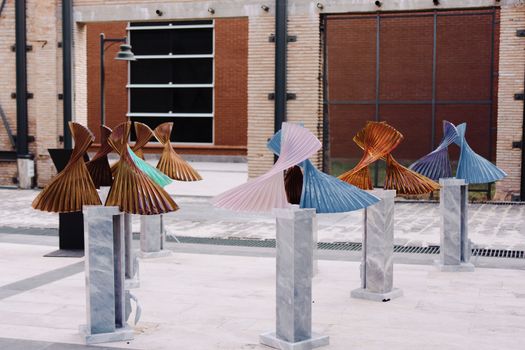
Larger organisations have entered the field too. The NVIDIA AI Art Gallery, an online venue, hosted AI and the Anvil in 2025, an online presentation of AI-generated sculptural designs realised in metal with robotic fabrication by Alexander Reben. The CVPR AI Art Gallery 2025, staged at Music City Center, features an exhibition of AI artworks created using computer vision techniques such as GANs, diffusion models and NeRF. These are curated, juried spaces with academic weight behind them, not hobby projects.
Why the current wave looks the way it does
The technical range on display explains a lot about the aesthetic. The CVPR gallery alone spans GANs, diffusion models and NeRF, which means the exhibited work runs from still imagery through to learned 3D representations. Panspermia takes machine learning into moving image. Subtle Bodies shows a very different approach, where an artist trains systems on her own figurative watercolours so that the output carries her hand rather than replacing it. CUSP leans on chance, inserting found images into a remembered landscape. None of these are the same gesture, yet they sit comfortably under one roof.
That diversity is a strength. A gallery that only showed one style of AI output would tire quickly. A gallery that mixes video, painting-derived work, 3D scenes and machined sculpture starts to look like a genuine movement rather than a novelty.

AI is moving into gallery operations
Art-making is only half the story. Art Circles describes itself as the first platform bringing AI into art world operations at scale, and it is built for galleries, fairs and cultural organisations rather than for individual image makers. Read that carefully and it points somewhere different: administrative systems, scheduling, audience handling and the unglamorous machinery that keeps exhibitions running. If that approach takes hold, the next visible change in galleries may not be the artwork on the walls but the speed at which shows get organised.
Selling AI art online: the practical layer
For most working artists, the question is commercial. Some platforms have positioned themselves deliberately around openness. Edge of Humanity, for instance, offers artists a commission free and contract free online platform to sell their creations and engage with clients through portfolio pages. Pixel Gallery’s article from 22 September 2023 argues that AI-generated artwork offers personalisation options, accessibility and affordability, and that it supports emerging artists entering the field.
Two things are worth checking before you commit to any route. First, the legality of selling AI-generated art depends on where you are and what the work was trained on, so treat it as an open question and take proper advice rather than relying on forum consensus. Second, platform policies differ. Some sites have restricted or banned AI art, and those rules change, so confirm the current terms directly with each platform before uploading.
What buyers respond to
The commercial case for AI art has leaned on gift giving. Pixel Gallery’s piece frames the buyer as the tech enthusiast who already owns every gadget worth owning and is hard to shop for, which makes a distinctive digital piece an easy solution. Personalisation and lower price points do a lot of work in that argument.
There is a collector side as well. Artists who sell through established marketplaces such as ArtPal and Fine Art America are plugging into audiences that already trust the checkout process, which removes a layer of friction that a self-built gallery adds. The lesson is straightforward: the exhibition experience and the transaction experience do not have to live in the same place.
Directions the next few years may take
Nothing here is settled, but the signals in the current material suggest a few plausible paths.
- More hybrid shows. Virtual venues built in minutes sit naturally alongside physical exhibitions, and an online presentation of sculptural work realised in metal shows the two ends can meet.
- AI behind the scenes. If Art Circles delivers on its operational promise, galleries and fairs may adopt AI quietly, without it becoming part of the public story.
- Deeper links to fabrication. Robotic fabrication turns screen-based design into physical objects, which is a far more interesting proposition for collectors than another file.
- More curation, not less. As volume rises, the gallery role grows in importance. GANs, diffusion models and NeRF already produce more output than anyone can view, so the act of choosing becomes the scarce skill.
What this means for independent artists
For a working artist, the practical takeaway is to treat an online gallery as a portfolio decision rather than a single upload. Keep a clean portfolio page that explains how each piece was made, because audiences respond better to process than to mystery. Enter curated showcases where the fit is genuine. Use virtual gallery tools if you want a presentation that stands apart from an image grid. And be honest about your methods, since the legal and ethical questions around AI art are still being answered and a clear process record helps you either way.
The rise of AI art galleries online is not really about the technology any more. It is about institutions deciding that this work is worth wall space, virtual or otherwise, and artists deciding how they want to be represented inside that space.
Frequently Asked Questions
Are AI art galleries only online?
No, although the online side has grown fastest. Virtual venues, curated showcase sites and institutional galleries hosted by research bodies dominate the field. At the same time, physical settings appear in the mix, including an exhibition staged at Music City Center and sculptural work realised in metal, which shows that machine-assisted art is not confined to screens.
Can I sell AI-generated art?
That depends on your location, the platform and how the work was produced. Some outlets offer commission free and contract free selling, while others restrict or ban AI art entirely. Treat the legal position as unresolved, check each platform’s current terms directly, and take proper advice before relying on any single answer you read online.
What kind of AI artwork appears in galleries?
The range is wider than most people expect. Exhibited work includes video pieces created entirely with machine learning, series that mimic an artist’s own figurative watercolours, generative neural network projects, and AI-generated sculptural designs realised in metal with robotic fabrication. Computer vision techniques such as GANs, diffusion models and NeRF also feature in dedicated exhibitions.
Do I need expensive software to show work in a virtual gallery?
Not necessarily. Arte: 3D Art Gallery Studio is a free app designed for iPad that publishes virtual exhibitions, and one developer released a Godot-built gallery featuring AI-generated artwork for free on Itch.io. Cost is rarely the barrier. Time spent on curation, presentation and clear labelling of your process matters far more.
Where can I see AI art exhibitions?
Several routes are open. Curated showcase sites such as AI Art Online group works by artist and project. Institutions including the NVIDIA AI Art Gallery host online presentations, and conference galleries such as the CVPR AI Art Gallery 2025 stage themed exhibitions. Virtual gallery apps add another option, letting you walk through shows built by individual artists.